Property Management
Short-Term Rental Management
Find out how to use technology to manage everything with minimal effort.

Running a short-term rental can be a great way to generate income from your property while offering travelers unique stays. However, it comes with its share of responsibilities and often feels like a full-time job.
A property manager takes 20–35% of your gross revenue to do a job that, five years ago, you genuinely couldn't do yourself. Today, most of what they do (guest messaging, pricing, cleaning coordination, review management) can be automated for a fraction of that cost. The question isn't whether you can afford a property manager. It's whether you can afford not to learn what the alternatives look like before you sign that contract.
To help you make an informed decision, in this guide, we walk you through what you need to know about short-term rental management and look at how you can use technology to manage your STR property yourself with minimal effort.
What Is Short-Term Rental Management?
Short-term rental management refers to the process of overseeing the operations of a STR property rented on a nightly or weekly basis (typically less than 30 consecutive days). STR management includes everything from ensuring legal compliance and marketing the listing to managing bookings, coordinating cleaning and maintenance, and handling guest communications.
Managing short-term rentals differs from managing long-term rental properties. It requires spending a lot of time communicating with guests and marketing properties, far more than traditional property management. Since people typically book short-term rentals for holidays, it’s essential to focus on providing an exceptional guest experience and making stays memorable.
That means you need to equip your rental with modern amenities and ensure effective communication with your guests via messages at different touchpoints in their journey to provide them with the necessary information at the right time and answer their questions quickly. You also need to have a robust turnover process in place.
Managing a short-term rental can be rewarding, but frequent turnovers require commitment and a range of tasks that can take up a lot of your time and effort. Fortunately, you can choose from several options to make your life easier:
Hire a dedicated property manager to take care of everything so you can enjoy real estate passive income
Share your workload with a co-host
Self-manage your rental and use property management automation software to streamline routine operations and save time
Self-manage your rental and take advantage of agentic automation to build customizable workflows and automations tailored to your specific business needs.
To help you decide what’s best for your situation, we’ll take a closer look at each option.
Short-Term Rental Management: Hire a Manager
A professional property manager can manage your STR property and guests to keep everything running smoothly, ensure a pleasant guest experience, and keep your listing competitive and earning positive reviews.
Their responsibilities typically include:
Creating and optimizing listings on major booking platforms to attract more potential guests
Strategically pricing your property to increase occupancy rates and maximize revenue
Handling guest communication from initial inquiry to check-in and providing customer support during guests’ stays
Screening guests, implementing short-term rental agreements, and managing security deposits to minimize risks of property damage
Managing bookings, cancellations, and turnovers
Coordinating regular cleaning and maintenance between guest stays and addressing any urgent repairs
Restocking essential supplies between guest stays
Complying with local STR rules and regulations
Managing guest reviews
Hiring an experienced property manager to operate your short-term rental lets you enjoy the benefits of rental income without the day-to-day hustle, but their services come at a price. Under the commission-based pricing model, the standard range for full-service short-term rental management fees is 20 to 35% of gross revenue. However, the fees can range from 15% for partial service to 50% for full-service management in luxury, seasonal, and remote markets.
So should you hire a property manager for your rental? It depends on your circumstances, preferences, goals, and budget. Before you decide, explore your options.
If you decide to hire a pro to manage your STR property, you can use our service to find a vetted property manager based on your needs and goals.
Share Responsibilities with a Co-Host
Instead of hiring a full-service property management company, you can delegate some of your daily operational tasks to a co-host. This frees up your time while keeping you involved in your business and in control of major decisions. You can divide the hosting responsibilities based on your expertise, experience, and availability.
If you list your property on Airbnb, you can find an experienced co-host through the Airbnb Co-Host Network. You can also hire a STR property management company that offers co-hosting services.
A co-host’s responsibilities are flexible and can include
Listing optimization
Screening potential guests
Guest messaging
Check-in and checkout coordination
Arranging cleaning and maintenance
Managing calendar
Updating pricing
Review management
Restocking supplies.
Co-host fees are typically lower than full-service short-term rental management, ranging from 10% to 25% of gross booking revenue. They vary significantly based on the co-host responsibilities and the size and location of the rental property.
You can expect to pay 10-15% of the booking revenue for basic support that includes guest messaging, check-in and checkout coordination, review management, and basic calendar management. The standard tier (20-25%) also includes listing optimization, cleaning team coordination, and pricing oversight.
Automate Short-Term Rental Management
If you have time and don’t mind doing some extra work, you can self-manage your short-term rental and keep more money in your pocket. If you actively manage your short-term rental property, you can save on property management fees and qualify for more extensive tax deductions to reduce your tax liability.
Under the short-term rental tax loophole, you can use losses from STR properties generated by depreciation and cost segregation to offset active income sources like W-2 wages or business income. But if you hire a full-service property manager, they likely spend more hours managing the property than you do, and you lose the 100-hour test for material participation.
You can self-manage your property stress-free by streamlining routine operations with all-in-one property management software like Hospitable, which covers every aspect of short-term rental management. Hospitable comes with a comprehensive set of advanced features and AI-powered tools and can help you automate 90% of repetitive daily tasks.
If you have never used a PMS before, you can start with Essentials—it’s a free plan that gives hosts access to robust core property management tools without a monthly fee. You only pay if you opt for add-ons or upgrade your plan.
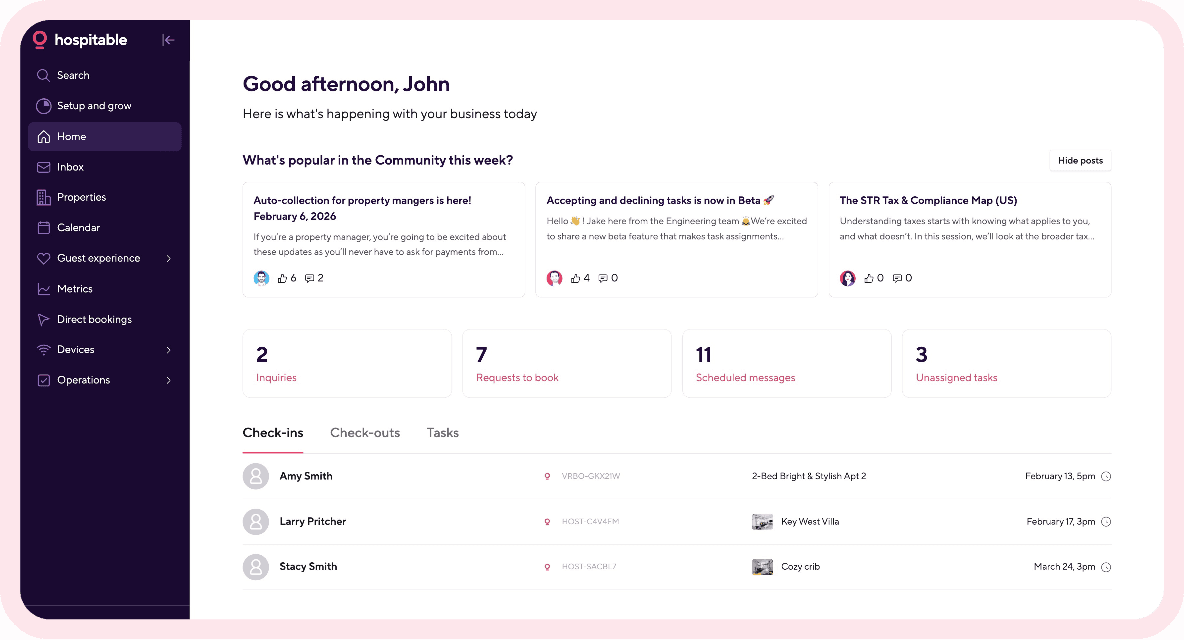
Self-management comes with many responsibilities. Let’s take a look at key aspects of short-term rental management that you can automate with Hospitable to reduce your workload, ensure that everything runs smoothly, and save time.
Guest messaging
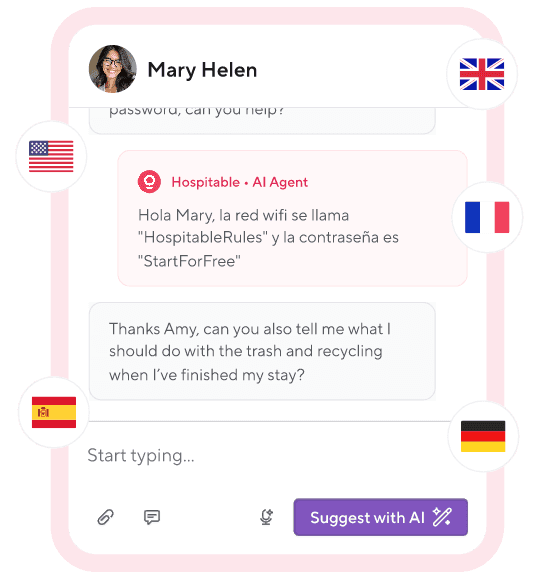
Guests expect accurate information and quick responses to their questions. Hospitable can help you streamline every step of the communication process to meet your guests’ expectations and offer consistent, personalized service. This can save you hours each week.
You can create message templates and set up rules to send them automatically based on the key moments in the guest journey, such as booking confirmations, check-in instructions, check-out reminders, and review requests.
You can let our AI handle common guest questions (about WiFi, parking, pets, etc.) if you set up automatic replies using your pre-written answers.
You can use Inbox AI tools to quickly draft detailed, personalized responses to unusual guest questions based on data sources available in your Hospitable account, including information that you’ve uploaded to the Knowledge Hub.
You can enable AI Auto Replies and let the AI respond to guest messages automatically without your review when you’re not online or even 24/7.
Coordinating cleanings
A large part of managing short-term rentals revolves around coordinating turnover cleanings and regular property maintenance. Make sure everything is spotless and in working order between stays. Hospitable allows you to automate assigning tasks to your cleaning crew based on your booking calendar. We’ll notify your cleaners about upcoming jobs via email or SMS.
With Hospitable Tasks, you can also invite your cleaners to their teammate portal where they can view upcoming and requested jobs, complete tasks and checklists, share updates, message you directly, and track their payouts. And you can monitor all your property tasks in one calendar and pay your cleaners when the job’s done.
You can also opt for automatic Marketplace Cleanings, and we’ll match you with reliable local cleaners from our partners’ network.
Automated self-check-in
Guests like the convenience and flexibility of self-check-in, so many hosts install smart locks that eliminate the need for physical keys and make check-in simple for both guests and hosts.
Hospitable integrates with several popular smart lock platforms to help you ensure a stress-free self-check-in. You can connect supported smart locks to your Hospitable account, and our system will sync them with bookings to automate access to your STR property. Hospitable will automatically generate unique access codes for each stay and share them with your guests via messages before check-in.
Our STR super app also integrates with popular smart thermostats, making it easy for hosts to automatically control the temperature at their properties, enhance guest comfort, and save time and money.
The best part is that smart device management is included in the Hospitable subscription cost on Professional and Mogul plans. Most PMS charge extra for self-check-in.
Dynamic pricing
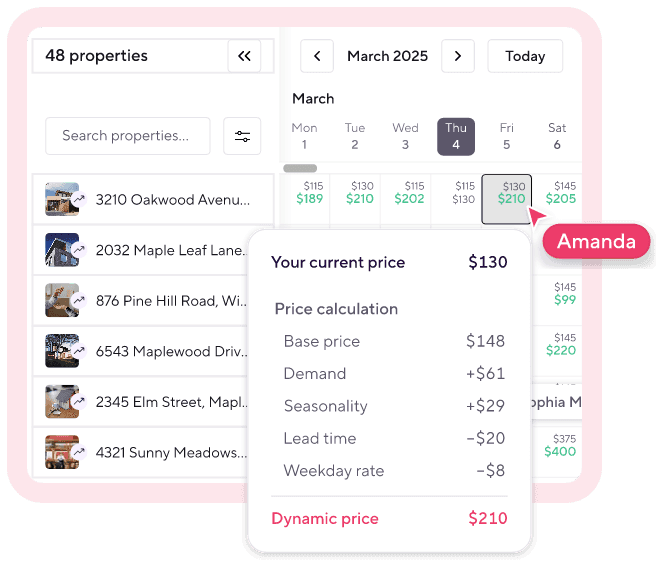
In today’s constantly changing market, leaving your nightly rates static is one of the fastest ways to leave money on the table. You should update your prices at least once every 24 hours based on competitor occupancy and local demand. A dynamic pricing strategy is the only way to stay competitive, keep your calendar full, and maximize your income.
To help you save money on third-party dynamic pricing tools, Hospitable provides a built-in Dynamic Pricing solution, which is included on Host, Professional, and Mogul plans at no extra cost. If you enable our built-in Dynamic Pricing for your property, Hospitable will automatically adjust your nightly rates based on market demand, seasonal trends, competition, your strategy, and other factors to help maximize revenue and optimize occupancy. Your rates update instantly across your connected channels, including Airbnb, Vrbo, Booking.com, and Agoda, as well as your direct booking website.
Risk management
Running a vacation rental comes with risks of property damage and guest issues. That’s why you need to protect your property and your guests and avoid neighbor complaints: screen your guests, ask them to sign a short-term rental agreement, and charge a security deposit. These steps help filter out troublesome guests.
With Hospitable, you can implement these measures without doing extra administrative work. You can add an automated security deposit to any of your properties, and Hospitable will automatically collect it before check-in and release it to your guests after checkout if no charge request is submitted.
You can create an agreement template, and Hospitable will populate it with guest and booking data to generate a rental agreement for each reservation and add it to the Guest Portal as a registration task. Your guests will be able to sign their rental agreement digitally.
You can also request ad-hoc verification of any guest who booked your property and assess potential risks before check-in. Then, the guest must upload a photo of their government-issued ID and take a selfie.
Channel manager
For STR hosts, adopting a multichannel distribution strategy is a secret to thriving in a competitive market. By listing your short-term rental property on multiple booking sites, you can maximize visibility, diversify your guest audiences, increase booking volume, and ultimately maximize your revenue.
Managing listings across multiple platforms manually can be time-consuming and complex, with risks of double bookings, inconsistent pricing, and operational chaos. The good news is that as a vacation rental channel manager, Hospitable allows you to manage listings across multiple channels easily in a single centralized dashboard.
We’ll protect your listings on major booking channels, such as Airbnb, Vrbo, Booking.com, Agoda, and Google Vacation Rentals, from double bookings with instant calendar sync. You can also use iCal imports to sync bookings from niche sites like Expedia or Hopper and keep your calendar updated without manual effort.
Direct booking website
Although OTAs make it easy for hosts to reach potential guests, you can’t rely on them alone if you want to build a sustainable business. Hospitable can help you reduce your reliance on OTA platforms and save on their commission fees.
With Hospitable, you can easily create a modern, mobile-friendly direct booking website for your properties using our professional, easy-to-customize website templates to drive repeat direct bookings. We’ll also list your property on Google Vacation Rentals, so travelers will be able to discover it when they use Google to search for a place to stay, and you’ll have a chance to get direct bookings without paying high third-party fees.
Upsells
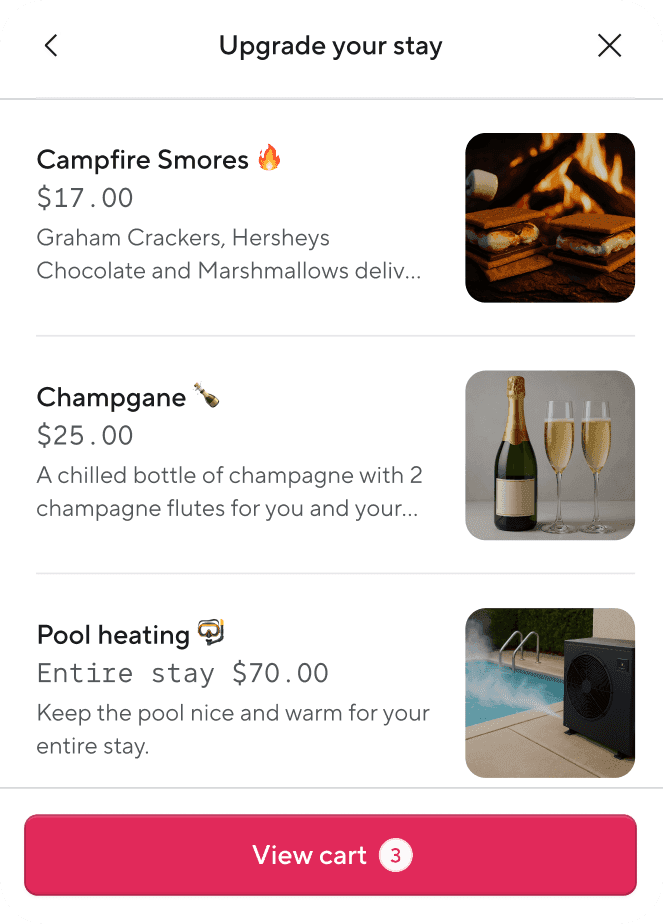
Offering guests valuable add-on services and amenities that enhance their experience is a great way to increase your revenue per booking and boost your bottom line. Many guests will happily pay for such extras as early check-in, late checkout, luggage storage, pet-friendly packages, grocery delivery, or local tours.
Hospitable comes with an Upsells feature, so you can offer paid upsells to your guests directly through the Guest Portal without manual work. Just create a catalog of your offerings and let your guests choose upgrades while planning their trip or during their stay. If your guests purchase anything, Hospitable will handle payments, payouts, and taxes.
Tracking your performance
Tracking your business performance is an essential aspect of short-term rental management. Monitoring and analyzing vacation rental metrics can help you understand how your business is doing, identify strengths and areas for improvement, and adapt your strategy accordingly.
With Hospitable, you can easily track key performance metrics using Metrics Dashboards and make informed pricing or operational decisions based on reliable data. Depending on your subscription plan, you can explore the pre-built dashboards to get quick insights, build your own fully custom dashboards to track the metrics that matter to you, add pre-built widgets from the library, and apply filters and groupings to focus on a specific slice of your data.
Hospitable also gives you access to Copilot. It’s your personal AI assistant, designed to provide you with instant insights and help you analyze your properties’ performance and manage operations more efficiently. You can ask Copilot questions in plain English, and it will analyze your account data to provide you with answers that match your actual business.
You can use Copilot to check revenue, occupancy rates, and booking trends, analyze guest feedback to find improvement opportunities, view upcoming tasks, get cancellation numbers, and much more.
Use Hospitable MCP and Let AI Handle Operations
As you can see, Hospitable offers advanced functionality and AI tools that can help you automate key operations and 90% of routine short-term rental management tasks and run your business on autopilot. But with Hospitable MCP server, you can connect a supported AI agent, like ChatGPT or Claude, to your Hospitable account and use it to help automate workflows that are unique to your STR business.
You don’t need any coding skills to connect an AI agent to Hospitable. Simply add Hospitable’s MCP server URL to the AI agent you already use and authorize access. Remember that you stay in control of what the AI can do in your account, and you can revoke access at any time.
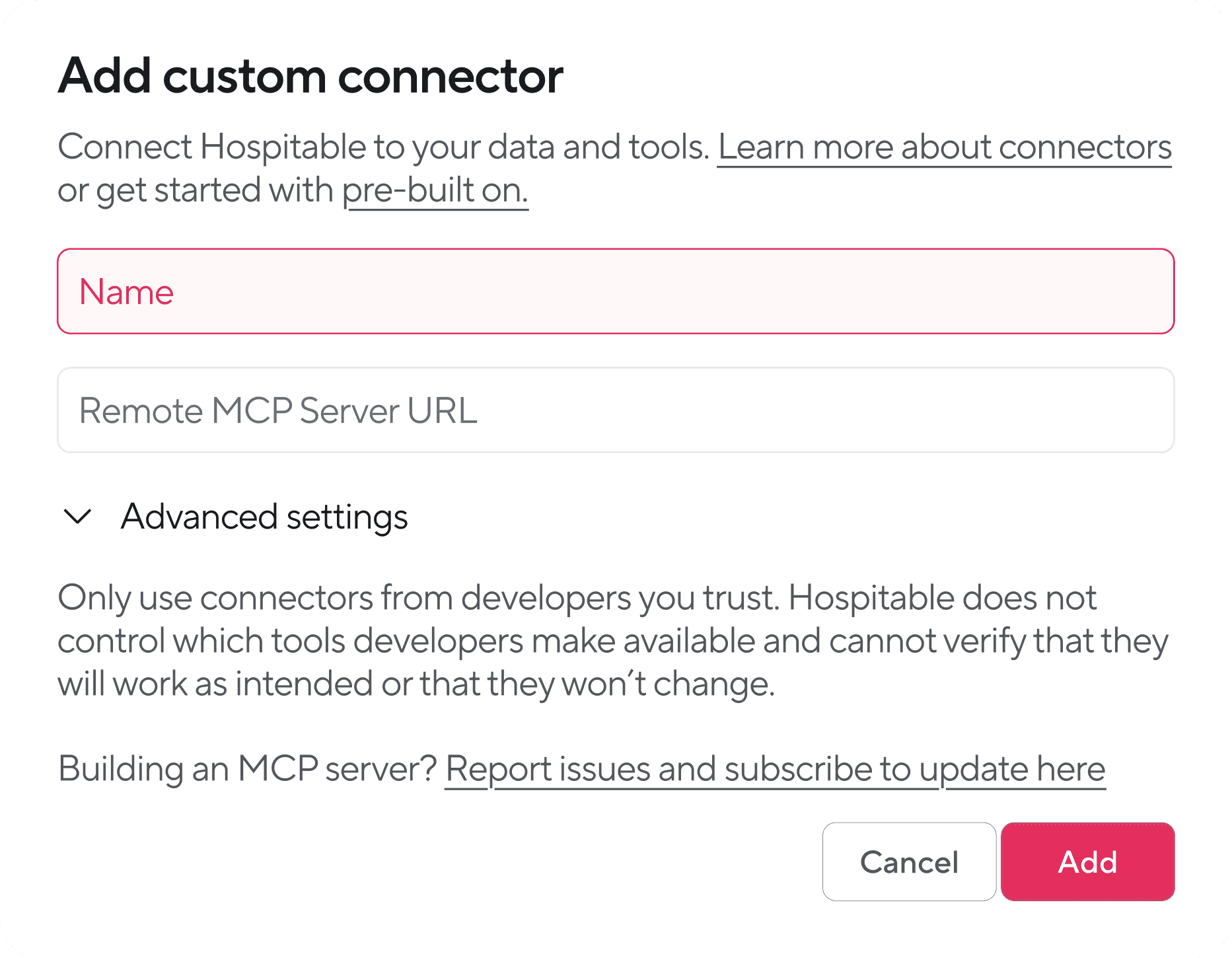
Once connected, the AI can operate within your Hospitable data environment and use available MCP tools to
Retrieve and analyze live data (properties, reservations, tasks, calendars, transactions, and more)
Answer operational questions
Perform actions according to your instructions without supervision.
Just tell the AI what you want in plain English, and let it handle operations for you. With Hospitable MCP, you can automate any aspect of short-term rental management the way you like, build AI-powered workflows that solve your unique hosting challenges, and manage your business with simple prompts.
You may want to check out our blog article to learn more about using AI for property management and find examples of how Hospitable users are leveraging the MCP server to build automated workflows tailored to their specific business needs.


Table of contents
Common questions
What is short-term rental management?
Short-term rental management is the process of overseeing a property rented on a nightly or weekly basis, typically for stays of less than 30 consecutive days. It covers both operational work and the guest experience, from legal compliance and marketing to bookings, turnovers, maintenance, and communication.
What does short-term rental management include?
Short-term rental management can include listing creation and optimization, pricing, guest communication, guest screening, rental agreements, security deposits, booking and cancellation management, cleaning and maintenance coordination, supply restocking, legal compliance, and review management.
Do you need a property manager for a short-term rental?
No. You can hire a full-service property manager, work with a co-host, or self-manage the property using automation software. Full-service managers typically charge about 20–35% of gross revenue, while co-hosts generally charge less and handle only selected responsibilities.
Can you manage a short-term rental yourself?
Yes. Hosts can self-manage by using property management software to automate repetitive work such as guest messaging, cleaning coordination, access codes, pricing, risk management, channel synchronization, and performance tracking. Hospitable is designed to automate most routine management tasks, allowing hosts to keep control of the business without outsourcing full-service management.