Starting an STR Business
Property Management
Short-Term Rental Regulations in the US
STR regulations vary significantly from one city to the next. Find out how they work in the US, what issues they address, and how to stay compliant.

Compliance is key to running a sustainable and profitable STR business. However, vacation rental regulations change frequently and vary significantly by jurisdiction, directly shaping what a property can earn.
If you manage properties across more than one market, staying compliant with changing short-term rental regulations is a challenge. In this guide, we explain how short-term rental regulations work in the US and outline their main categories.
Short-Term Rental Regulations: How They Work in the US
Short-term rental regulations are legal rules that govern how vacation rentals operate, balancing economic benefits with community concerns like housing availability, noise, and safety. These policies determine whether, where, and how a property can be rented to guests for short stays. STR regulations cover registration and licensing, taxes, zoning rules, rental limits, health and safety standards, and platform compliance.
There is no single national law that governs short-term rentals in the United States. States, counties, and cities set the rules, and local rules are usually the strictest and most variable. So, before we start discussing the main categories of short-term rental regulations, it helps to understand the structure.
State level. State governments set the framework, including whether to require statewide licensing, sales or lodging tax registration, and whether to mandate platform tax collection. Some states, for example, Idaho, Florida, and Arizona, enforce preemption laws that limit cities’ ability to regulate short-term rentals. In states without such laws, cities and counties generally have broader authority to regulate short-term rentals, within the powers granted to them by state law.
County level. Counties regulate land use and set permit rules for unincorporated areas outside city limits. A property just outside a town may need a county permit even if the nearby city has its own different laws.
City or municipal level. City governments set the practical rules that hosts face inside city limits, including zoning, permits, registration, occupancy limits, noise restrictions, primary residence requirements, and caps on the number of licensed STRs per neighborhood.
HOA/condo level. Homeowners Associations (HOAs) and condo boards add a private layer of governance. They can impose restrictions (limitations on rental duration, guest parking, noise level) or completely prohibit short-term rentals within their governed communities even if city or state laws permit them.
Whether you're renting out a spare room or building a rental portfolio, it’s essential to understand and follow all of the rules and requirements for STR businesses. You need to know what is allowed in your area before you start a short-term rental. Compliance isn't just a legal obligation; it's also a cornerstone of your success.
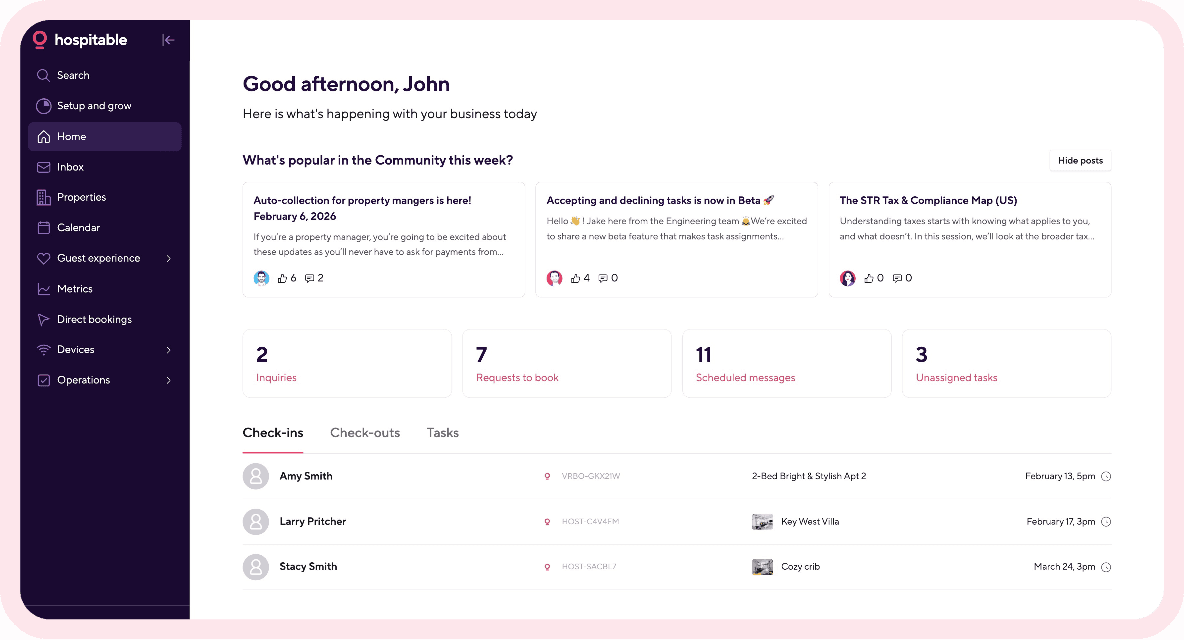
You’ll be able to grow a successful short-term rental business faster if you automate routine property management tasks using all-in-one short-term rental software like Hospitable.
Short-Term Rental Regulations: Main Categories
Now, virtually every major US city has some form of short-term rental rules in place, ranging from light-touch registration requirements to near-total bans on whole-home rentals. For example, Houston has no zoning and relatively light STR rules: hosts must register each property annually, name an emergency contact, and complete human trafficking awareness training, but there are no caps or owner-occupancy requirements. Meanwhile, in New York City, hosts must register under Local Law 18, and rentals shorter than 30 days are allowed only if the host is present and has no more than two paying guests, which effectively bans whole-home short-term rentals.
Although the exact rules differ from one jurisdiction to another, most short-term rental regulations address several interconnected issues and fall into a few core categories.
Registration and licensing
In most jurisdictions, hosts are required to register their STR properties with local authorities, obtain specific permits or short-term rental licenses, complete annual renewals, and display a valid permit number on listings. OTA platforms like Airbnb or Vrbo are also required in many cities to verify registration before accepting listings and delist units that fail to comply.
Zoning rules
Local zoning rules determine where short-term rentals are legally allowed to operate. Zoning rules are among the most restrictive and most variable categories of regulation. Municipalities may restrict STRs to specific zoning districts, such as commercial or mixed-use areas. Some jurisdictions prohibit short-term rentals in certain zones (e.g., residential areas or neighborhoods with specific historic character) or require the property to be the owner's primary residence.
For example, in New Orleans, short-term rentals in residential zones are heavily restricted—only one rental is allowed per square block, with licenses allocated by lottery, to prevent clustering, and the operator must live on site while guests are staying.
Owner occupancy requirements
Regulations may require that property owners fulfill certain occupancy requirements, such as maintaining a permanent residence on the property or living there for a minimum number of days annually. Cities can also cap the number of days per year hosts can rent their STR and limit guests per stay, usually by setting a guests-per-bedroom or per-property cap.
For example, jurisdictions such as Los Angeles, San Francisco, and Washington, DC require the short-term rental property to be the host's primary residence. San Francisco and Washington, DC also cap unhosted stays at 90 nights per year, while hosted stays are not capped.
Note: For hosts navigating STR rules, the most important distinction is between hosted rentals when the host is present during the stay and unhosted rentals (whole-home rentals where the host is not present). Most US cities treat hosted and unhosted rentals differently, and unhosted rentals usually face stricter night caps, primary-residence requirements, and in some cases outright prohibitions.
Safety requirements
Safety standards typically require smoke and carbon monoxide detectors, fire extinguishers, posted emergency information for guests, emergency exit plans, and appropriate insurance coverage to protect against damages, injuries, and liability related to short-term rental activities.
Noise and nuisance controls
Cities can restrict short-term rentals for large gatherings and events, and they may require guests to comply with existing noise, trash, and parking ordinances. Many cities also require a local contact who can respond quickly to complaints from neighbors or inspectors.
For example, hosts in San Diego must designate a local contact who will be responsible for actively discouraging and preventing any nuisance activity. The local contact must respond within one hour to all reported complaints.
To prevent issues and avoid neighbor complaints, set clear house rules that inform guests about parking rules, noise limits, and occupancy restrictions. You can also ask your guests to sign a short-term rental agreement that outlines the house rules for guests and explains the penalties for breaking them.
Implementing STR agreements doesn’t necessarily mean doing more admin work to create a new contract for each reservation. With Hospitable, you can create templated rental agreements and automatically send them to your guests for signature as a registration task they need to complete in their guest portal to finalize their booking. You can also require your guest to go through ID verification as a part of signing the agreement.

Tax obligations
Short-term rentals are subject to local taxes, including occupancy taxes (also called lodging or hotel taxes) and sales taxes. Many jurisdictions now require OTA platforms to collect and remit taxes on behalf of hosts. However, some cities and states require hosts to handle tax collection and remittance themselves. Since tax rules vary by state, county, and city, hosts should always verify their specific tax obligations to avoid unexpected liabilities.
Staying Compliant with STR Regulations
Local regulations vary depending on the locality that issues them. Every jurisdiction sets its own rules, changes them on its own timeline, and enforces them differently. As a result, a short-term rental strategy that is fully compliant in one city can be illegal in the next town over. Short-term rental laws are also constantly evolving, so staying informed is essential for successful hosting.
Check local rules. Always research and understand the specific short-term rental laws in your area before listing or investing in a property. Start with zoning and land-use rules to confirm that short-term rentals are allowed at your address. Then read the city’s STR ordinance and any state or provincial laws that apply.
Check HOA rules. Verify compliance with private community restrictions alongside public law since homeowner association rules routinely prohibit what the city permits.
Meet registration requirements. Apply for the correct license and permits, and display your registration number on listings. Keep your registration current.
Register for tax collection. Confirm which taxes apply, who must collect and remit them, and how to file. If OTA platforms collect transient occupancy taxes on your behalf, you may still have duties to file them.
Meet safety standards. Install smoke and carbon monoxide detectors, maintain fire extinguishers, and have required insurance. Complete inspections and display emergency information.
Monitor regulatory changes. Stay updated because governments frequently adjust rules that may affect your ability to rent, and recheck short-term rental regulations every time you renew your permit.
Disclaimer: This article is for general informational purposes only and doesn’t constitute legal, tax, or financial advice. Short-term rental laws vary by state, county, and city, and they change often. The examples above reflect the rules at the time of writing and may no longer be current. We don’t monitor or update this article to reflect every legislative change. Before you list or buy a property, check the official sources for your jurisdiction, such as your city’s STR ordinance, your county and state requirements, and your HOA rules. Consult a qualified local attorney or tax professional about your specific situation.


Table of contents
Common questions
What are short-term rental regulations?
Short-term rental regulations are legal rules that govern whether, where, and how properties can be rented to guests for short stays. They commonly address licensing, taxes, zoning, rental limits, health and safety standards, and platform compliance.
Who regulates short-term rentals in the US?
There is no single national short-term rental law in the US. Rules can be set at the state, county, and city or municipal levels, while HOAs and condo boards may impose additional private restrictions. Local rules are often the strictest and most variable.
What are the main types of short-term rental regulations?
The main categories include registration and licensing requirements, zoning rules, owner-occupancy and rental limits, safety standards, noise and nuisance controls, and tax obligations. The exact combination and severity of these rules varies by jurisdiction.
What is the difference between hosted and unhosted short-term rentals?
A hosted short-term rental is one where the host is present during the guest’s stay, while an unhosted rental is a whole-home stay where the host is absent. Many US cities regulate unhosted rentals more strictly, often applying tighter night caps, primary-residence requirements, or outright prohibitions.
How can hosts stay compliant with short-term rental regulations?
Hosts should check local zoning and STR ordinances before listing, review HOA or condo rules, obtain and renew required licenses, confirm tax collection and filing obligations, meet safety standards, and monitor regulatory changes. Because rules can differ between neighboring jurisdictions and change over time, review compliance regularly.