Beginner's Guides
OTAs
Starting an STR Business
Booking vs. Airbnb: Which Platform Is Better for Hosts?
Not sure which OTA platform to choose to list your vacation rental home—Airbnb or Booking.com? Both platforms are popular among travelers and have millions of daily visits, so it's better to take a closer look at both. Check this post for an in-depth comparison!

Not sure which OTA platform to choose to list your vacation rental home—Airbnb or Booking.com? With more than 6 million active listings and a global brand identity, Airbnb may seem like a logical choice. But with over 28 million listings worldwide, Booking.com is now the largest vacation rental platform.
Both platforms are popular among travelers and receive millions of daily visits, so it is worth taking a closer look at them.
Rather than restate what the two companies publish about themselves, we turned to our own data: US properties connected to Hospitable that run on both channels at once, covering 12 months of bookings, occupancy, stay length, and cancellations. Guests on Booking.com cancel 28.7% of the time, compared with 16.5% on Airbnb. The same house, the same period, two very different outcomes.
Booking.com vs. Airbnb: How Do Guests Differ?
Each of these platforms attracts a specific audience. Airbnb is popular among Millennials who are more interested in authentic experiences. They are looking for unique rentals with a “home-away-from-home” atmosphere where they can live like a local in their chosen city or town. Airbnb guests prefer rental properties that offer one-of-a-kind, Instagram-worthy experiences, such as themed houses, castles, forest cabins, or yurts.
Airbnb guests know they will be staying on private property, so they tend to chat with hosts before booking to learn more about the requirements and house rules. As a result, they know exactly what to expect during their stay, almost always have a good experience, and give hosts positive reviews.
Airbnb users are eager to ask questions about your property and expect fast answers. So communication with guests may take up a lot of your time, especially during a peak season. But you can automate guest conversations with short-term rental software like Hospitable.
You are in control of how much automation you want to have. From simple scheduled messages to AI-based responses sent without your review, with plenty of options in between.

On Airbnb, hosts can also leave a review for their guests and give them a star rating, which is visible on a guest’s profile. This feature is extremely useful for hosts because it allows them to check a traveler's past reviews before accepting a reservation. Airbnb hosts can vet their guests and decline reservations if guests have a low rating or no reviews. Hosts can do it after they switch off the Airbnb Instant Book feature.
Booking.com has always been a website for promoting hotels, resorts, and lodges, and not private vacation rental homes or individual rooms. Everything has changed in recent years, and now Booking.com is attracting more vacation rental properties, but the platform’s users might still be more demanding.
Guests on Booking.com tend to prioritize convenience and might expect a place with hotel-like amenities and standards, such as 24-hour check-in. Chances are you will end up with a negative review for the same amenities that may give you a positive review on Airbnb. Booking.com hosts don't leave reviews of their guests on the site, and by default, incoming reservations are confirmed instantly. However, hosts can enable the Request to Book feature to review and approve each reservation before it's confirmed. Without it, you could end up with a problematic or badly behaved guest.
You can add an extra layer of protection by requesting additional guest screening with Hospitable. Works for Airbnb, Booking.com, and other OTAs.

The bookings themselves are shorter. On US properties running both channels, the average stay is 3.14 nights through Booking.com against 3.62 nights through Airbnb. Half a night does not sound like much until you multiply it across a year of turnovers, since every booking carries the same cleaning and the same changeover work regardless of how long the guest stays.
The table below summarizes the main differences between Booking.com and Airbnb. We compare these two global OTA platforms across the following categories: number of listings, global presence, property types, target audience, commissions, host payouts, and host protection. Hopefully, this info can help you decide when choosing an online booking platform to list your home.
Booking.com | Airbnb | |
Number of listings | Over 28 million | More than 7.7 million listings |
Global presence | Operates in more than 220 countries | Operates in more than 220 countries |
Types of property | Hotels, resorts, lodges, entire vacation rental properties | Hosts can list entire places, private rooms, and shared rooms. |
Target audience | Attracts business and leisure travelers who prioritize convenience and may expect hotel-like amenities and standards. | Popular among Millennials who are more interested in authentic experiences and unique rentals like castles, forest cabins, or yurts. |
Commissions | The standard commission is typically 15%. | With the host-only fee, hosts pay around 15% of the booking subtotal. Guests pay around 14% of the listing price with a split fee, and hosts are charged 3%. |
Host payouts | There are two solutions for hosts: Payments by Booking.com and Online Payments, but not all are available in every country or for every property type. | The platform collects guests’ payments on the host’s behalf and pays them to the vacation rental owners through the chosen payout methods. |
Host protection | Partner Liability Insurance (up to $1M) and Host Property Insurance (up to $1M in damage protection in select markets). | AirCover for Hosts includes $3M for damage protection and $1M for liability insurance. |
Booking vs. Airbnb: Commissions
Both Airbnb and Booking.com charge hosts a rate per booking they receive. So it’s crucial to understand how much you will pay in fees for using both sites.
Airbnb has two fees: the Split Fee and the Host-Only Fee. The Split Fee is split between guests, who pay around 14% of the listing price to Airbnb, and hosts, who pay around 3%. With the Host-Only Fee, hosts pay around 15% of the booking rate, and guests aren’t charged a booking fee. The Host-Only Fee has become mandatory in most countries but not in the United States.
Booking.com doesn’t charge guests any booking fees. But it charges hosts an average commission rate of 15% of the total booking price, which hosts need to pay back at the end of every month. This is about the same rate as the Host-Only Fee on Airbnb.
Booking.com vs. Airbnb: Host Payouts
Airbnb takes a more direct approach and automatically collects guests’ payments on the host’s behalf. It pays the rental owner via the chosen payout method 24 hours after guest check-in.
Booking.com offers hosts two payment solutions: payments via Booking.com and online payments. Hosts can choose to have Booking.com facilitate all of their guests' payments and receive automatic payouts by bank transfer for completed prepaid and online-paid reservations. Hosts can also allow guests to choose between paying online and paying at their property (meaning Booking.com only handles online payments).
How Do the Cancellation Policies Compare?
Airbnb currently offers several cancellation policies that hosts can choose from: Flexible, Moderate, Firm, Strict, Strict Long-term, Flexible Long-term, Super-strict (30 days), Super-strict (60 days), and non-refundable option. Each varies depending on how close to the check-in date guests are allowed to cancel and receive refunds, and each policy has its pros and cons. Still, cancellation rates on Airbnb are quite low because guests make a payment when they book your place.
On Booking.com, there are fewer options for hosts regarding cancellations. Booking.com recommends that hosts allow guests to cancel for free until one or two days before check-in. Alternatively, hosts can choose non-refundable policies, where guests won’t get their money back if they cancel. You can also charge a deposit or prepayment, or hold a pre-authorization amount.
Most Booking.com listings don’t require prepayment and offer free cancellation. It’s very convenient for guests and not fun for hosts, so cancellation rates are higher on Booking.com. That means that hosts need to adjust their calendars regularly and ensure correct availability dates in their Airbnb and Booking.com calendars.
We can put a number on that. Across US properties listed on both platforms, 28.7% of Booking.com reservations end in cancellation, against 16.5% on Airbnb. Nearly one in three against roughly one in six, on the same properties over the same twelve months. The gap follows the policies: free cancellation with no prepayment is the default on Booking.com, and guests behave accordingly.
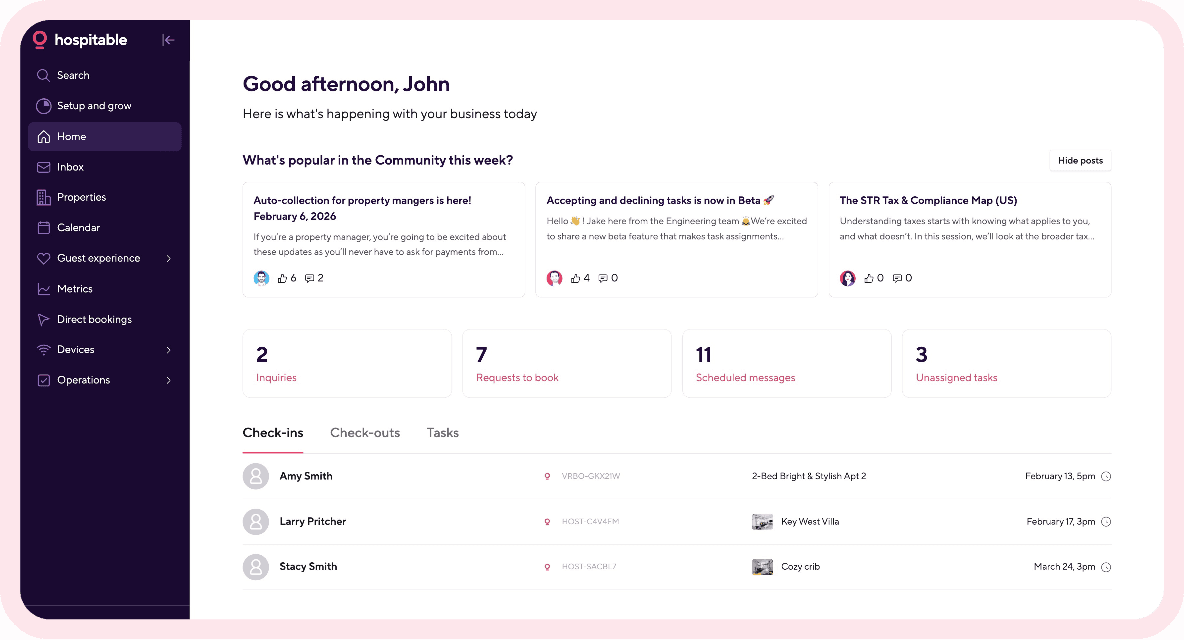
Managing your vacation rental calendar manually can be challenging and time-consuming, especially if you have multiple listings. A good solution is to use short-term rental software with a channel manager feature, such as Hospitable. Our tool will manage your listings and synchronize your calendar across all your platforms, automating almost all routine operations and saving you a lot of time.
What about Host Protection?
Renting out your property short-term will help you earn extra income, but it’s important to protect your rental property against damage and yourself against personal liability claims. Airbnb protects property owners through AirCover for Hosts. It’s top-to-bottom protection that provides hosts with $3 million in damage coverage and $1 million in liability insurance.
Booking.com offers Partner Liability Insurance (up to $1,000,000 in coverage, available globally), Host Property Insurance (up to $1 million in damage protection from guests, at no extra cost in select markets), and a damage deposit option that hosts can configure for their properties.
Booking vs. Airbnb: Where Should You List Your Rental?
Should you list your rental property on Airbnb or Booking.com? It’s really up to you. Both platforms provide an amazing opportunity for property owners to start the STR business and get additional income. But if you want to maximize your reach and secure more bookings, it’s better to use a multi-channel strategy and list your property on several platforms.
You may use Airbnb as your primary platform and list your property on Booking.com to access a wider market and expand your pool of potential guests.
If you already have an Airbnb listing, you can create a Booking.com listing with a few clicks with Hospitable.
Our data supports the multi-channel case. US properties running both Airbnb and Booking.com show 75.8% occupancy over the last 12 months, against 57.5% for properties on Airbnb alone.
That is a gap, not a mechanism. Hosts who add a second channel tend to differ from the rest in portfolio size and in how much else they have set up. Adding a channel does not fill a calendar on its own.



Table of contents
Common questions
Is Airbnb or Booking.com better for vacation rental hosts?
Neither platform is universally better. Airbnb tends to attract guests looking for unique, experience-driven stays, while Booking.com reaches a broader audience that often expects hotel-like convenience. Hospitable data from US properties listed on both platforms also shows meaningful operational differences: Booking.com bookings cancel more often and have shorter average stays than Airbnb bookings.
Which platform has a higher cancellation rate: Airbnb or Booking.com?
Booking.com has the higher cancellation rate. Across US properties connected to Hospitable and listed on both platforms, 28.7% of Booking.com reservations were canceled, compared with 16.5% on Airbnb over the same 12-month period. The difference aligns with Booking.com’s broader use of free-cancellation policies and bookings without prepayment.
Are stays longer on Airbnb or Booking.com?
Stays are longer on Airbnb. For US properties connected via Hospitable running on both channels, the average stay was 3.62 nights on Airbnb versus 3.14 nights on Booking.com. Shorter stays can increase turnover workload because every reservation still requires cleaning and changeover regardless of length.
Should you list your vacation rental on both Airbnb and Booking.com?
Yes, a multi-channel strategy can help you reach different guest segments and reduce dependence on a single OTA. Airbnb can serve as a strong primary channel, while Booking.com expands your exposure to travelers who may not search on Airbnb. Using both also increases the importance of synchronized calendars and pricing to avoid double bookings and availability errors.
Do hosts get higher occupancy by listing on both Airbnb and Booking.com?
In Hospitable’s US data, properties listed on both Airbnb and Booking.com had 75.8% occupancy, compared with 57.5% for properties listed only on Airbnb over the previous 12 months. This is a correlation, not proof, that adding Booking.com directly causes higher occupancy, because multi-channel hosts may also differ in portfolio size and operational maturity.