Property Management
Short-Term Rental Tax Reporting 101
Short-term rental tax reporting is an important part of tax compliance. In this guide, we explain the key concepts that you need to know as a host.

Whether you rent out a second home for a few weeks a year or manage multiple STR properties, your rental income may be subject to federal, state, and local taxes. Navigating tax requirements and staying compliant with tax authorities is crucial for smooth operations.
An important part of tax compliance is tax reporting, so if you own or are considering a short-term rental property, you should make sure you understand the process. Vacation rental tax rules are more nuanced than most STR owners realize, and it’s easy to miss something that could cost you later.
So, in this blog, we’ll explain the key concepts you need to know for accurate short-term rental tax reporting, including types of taxes that need to be reported and how reporting on Schedule E differs from Schedule C.
Types of Taxes
First, it’s important to understand that there are two different types of taxes that need to be reported when you operate a short-term rental: income taxes and local lodging or occupancy taxes.
Income taxes are levied by the federal government and most state governments as a percentage of your total income. As a host, you pay these taxes out of your own pocket, and they’re due once a year.
Occupancy taxes are levied by states, counties, cities, and other jurisdictions on STR accommodations. Your guest pays the tax. However, you’re responsible for collecting the tax, filing occupancy tax returns, and paying it. Depending on the jurisdiction, occupancy taxes can be due monthly, quarterly, or annually.
Here is what you need to know about reporting for each type of tax.
Reporting Income Taxes
In general, you’re required to report all the income you receive from short-term rentals to the IRS as part of your total income. The rental income includes revenue from all your channels, including online travel platforms like Airbnb and Vrbo, as well as any direct bookings you get.
You must report all rental income you’ve collected from guests, including nightly rates, cleaning fees, pet fees, and any other amounts paid by guests. However, you can lower your tax burden by claiming short-term rental tax deductions (ordinary and necessary expenses related to running your STR property).
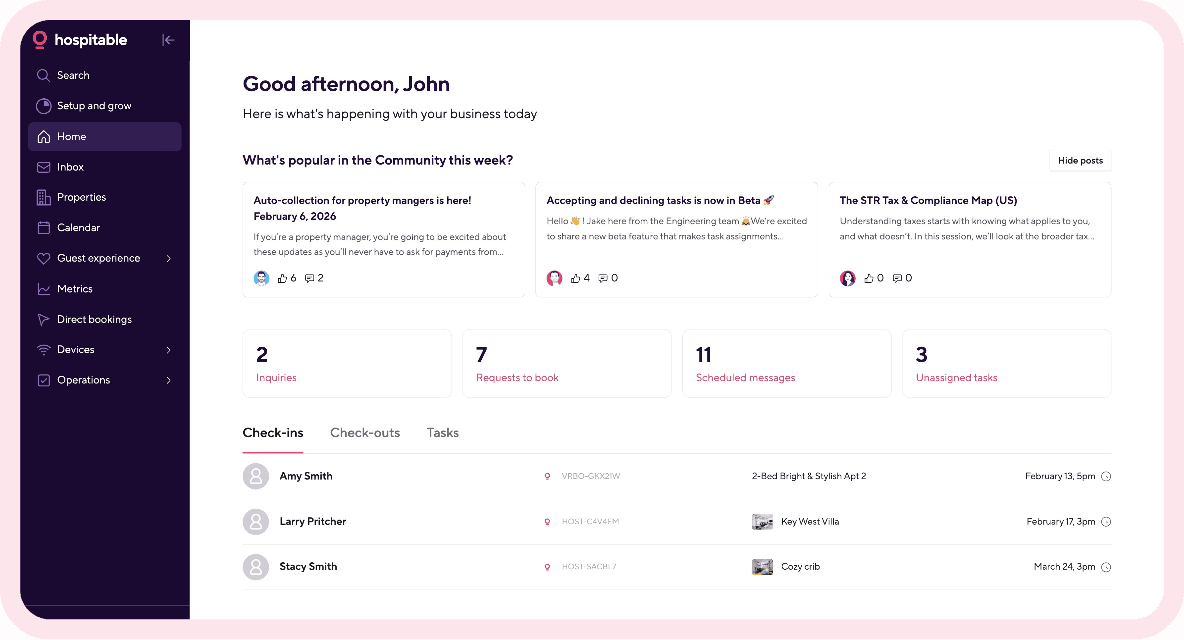
If you manage several STR properties and list them on multiple channels, tracking income from all your sources is a challenge. That’s why it’s essential to use a robust PMS like Hospitable that streamlines your operations and consolidates all your booking data and revenue streams into a single, centralized dashboard. With Hospitable, you can run your STR business on autopilot and have one source of truth, instead of pulling reports from multiple platforms.
There’s an exception to the requirement to report your short-term rental income. Under the 14-day rule, if you rent out your home for 14 days or fewer in a year, and use it personally for more than 14 days, you don’t have to report the rental income at all. But you also can’t deduct any expenses as rental expenses.
Reporting your STR income: Schedule E vs. Schedule C
Reporting short-term rental income requires specific tax forms. Choosing the right tax form depends on how you operate and how the IRS views your rental activity.
Schedule E is typically used for rental income reporting if you only provide ordinary rental-related services, such as utilities, cleanings between stays, essential amenities, basic repairs, and maintenance. The income you report on Schedule E is not subject to self-employment tax.
Use Schedule C when you provide substantial services to your guests for their convenience, such as in a hotel: regular cleaning during a guest’s stay, concierge services, or meals. Then the IRS may treat your activity as an active business, and your business income may be subject to self-employment tax. That adds 15.3% to cover Social Security and Medicare, on top of regular income tax.
It’s also worth noting that the IRS hasn’t issued comprehensive guidance for every short-term rental scenario, so many hosts fall into a gray area. How you document and present your activity, especially the guest services you provide and the level of participation, can influence the tax treatment of your short-term rental property. So, you should always discuss your specific operations with a qualified CPA.
Form 1099-K
Depending on your taxpayer information, number of transactions, state laws, and total amount you make, booking platforms like Airbnb and Vrbo may issue a Form 1099-K when federal reporting thresholds are met. But even if you don’t receive a 1099-K form, all taxable rental or business income must still be reported.
As the merchant of record and payment settlement entity (PSE), Hospitable is also required to issue Form 1099-K to all users who have received payouts from Hospitable that meet the reporting threshold. Form 1099-K reports gross payment transactions processed on your behalf through Hospitable’s platform. It includes payouts for Direct Premium bookings, upsells and commission on trip insurance sales, claimed security deposits, and owner payouts.
Reporting Occupancy Taxes
Local lodging or occupancy taxes often apply completely separate from federal requirements, and tax rules and rates vary widely, even within the same state. For example, one city might charge a percentage-based lodging tax, while a nearby town adds a fixed nightly fee. The occupancy tax reporting process may also be different for each jurisdiction.
Some booking platforms like Airbnb and Vrbo handle occupancy tax collection in certain areas in the US, but the coverage isn’t consistent. In many jurisdictions, they don’t collect taxes for hosts, and in others, they may collect some lodging taxes you owe, but not all. Even if Airbnb and Vrbo collect occupancy taxes for you, some jurisdictions still require you to file lodging tax returns to report your short-term rental earnings and the taxes they collected.
Missing any local taxes could result in penalties and interest, so you must research your local requirements and consult a tax professional if needed. You are ultimately responsible for tax compliance, especially for direct bookings. However, a good PMS like Hospitable can help you configure these taxes and ensure accurate tax reporting for your short-term rental business.
Hospitable provides tax collection and remittance services for Direct Premium bookings, Upsells, and Vrbo Partner reservations where Hospitable is the Merchant of Record. We calculate, collect, and remit occupancy and lodging taxes for you in 50 US states.

For the taxes we remit, you don’t need to register, file, or pay them in covered jurisdictions. We act as taxpayer of record and file and pay taxes under Hospitable’s name and taxpayer ID.
Occupancy and lodging taxes are calculated automatically based on your property and booking details, and we file returns and pay taxes directly to state and local authorities on your behalf.
Remittance is set for each tax individually, so a single property can have both taxes that Hospitable remits and pass-through taxes. Hospitable collects pass-through taxes from guests and includes them in your payout, and you’re responsible for filing and remitting them. You can check how each tax is handled under Properties → Pricing → Taxes. With Direct Premium, you’ll also sign a quarterly tax affidavit to confirm that pass-through taxes will be filed and paid.
How much of the work we take on depends on your plan. With Direct Premium, Hospitable remits supported taxes for you. With Direct Basic, Hospitable calculates and collects the taxes you set up, and you file and remit them yourself. Learn more in our help article.
Taxes on reservations from the Vrbo Partner connection work differently from Vrbo’s own tax collection, because Vrbo doesn’t process payments for PMS-connected listings. When Hospitable is the Merchant of Record, taxes on these reservations follow the same rules as Direct Premium bookings. If you choose Stripe instead, all taxes are passed through to you, and you file and remit them yourself. If you’re upgrading from the Vrbo Legacy connection, review your tax settings, because tax handling may change. Find the details in our Vrbo Partner tax guide.
For hosts who receive payouts from Hospitable for Direct bookings, Hospitable provides a few tax-related reports and documents. In addition to Form 1099-K, Hospitable will generate an annual earnings report, which gives you a complete picture of your Direct booking income, regardless of whether you meet the 1099-K threshold. You can also download a report of all taxes collected on your Direct bookings—it shows both collected and remitted taxes.
You can find more information on handling taxes in supported jurisdictions here.
This article is for general information only and isn’t tax, legal, or financial advice. Tax rules for short-term rentals vary by state, county, and city, and they change often, so always check the current requirements with the IRS and your state and local tax authorities. For advice on your specific situation, talk to a qualified CPA or tax professional before you file.


Table of contents
Common questions
What is short-term rental tax reporting?
Short-term rental tax reporting is the process of declaring rental income and applicable lodging or occupancy taxes to federal, state, and local tax authorities. It involves reporting revenue from all booking channels, documenting deductible operating expenses, and filing the appropriate income and occupancy tax returns. Reporting requirements and deadlines vary by tax type and jurisdiction.
What taxes do short-term rental owners need to report?
Short-term rental owners generally need to report two main types of taxes: income taxes and lodging or occupancy taxes. Federal and applicable state income taxes are paid on taxable income from rental activities. Occupancy taxes are typically charged to guests, but hosts may be responsible for collecting, reporting, and remitting them to state or local authorities. Income taxes are generally reported annually, while occupancy tax filings may be required monthly, quarterly, or annually.
What is the 14-day rule for short-term rental tax reporting?
Under the IRS 14-day rule, rental income is generally tax-free if you rent out your home for 14 days or fewer during the year and personally use it for more than 14 days or more than 10% of the total rental days. When these conditions are met, you don't need to report the rental income on your federal tax return, but you also cannot deduct expenses attributable to the rental activity.
How can hosts track income from multiple booking platforms for tax reporting?
Hosts can use short-term rental property management software to consolidate reservations and revenue from OTAs and direct bookings into a centralized dashboard. This makes it easier to track nightly rates, cleaning fees, pet fees, and other guest payments without manually combining reports from different platforms. Hospitable centralizes booking and revenue data, helping hosts maintain consistent financial records for tax reporting.
Can short-term rental software automate tax reporting and remittance?
Yes. Short-term rental software can automate certain tax calculations, collections, and remittances, depending on the booking channel, jurisdiction, and service plan. For example, Hospitable calculates, collects, files, and remits supported occupancy and lodging taxes for Direct Premium bookings and eligible Vrbo Partner reservations where it acts as Merchant of Record. For Direct Basic bookings, Hospitable calculates and collects configured taxes, while hosts remain responsible for filing and remittance. Hospitable also provides annual earnings reports and tax collection reports to support tax reporting.