

OTAs
Property Management
Short-Term Rental Tax Deductions Property Owners Can Claim
Find out what common business-related expenses you can claim to reduce your tax burden and how to qualify.

Renting a property for short guest stays through OTA platforms like Airbnb or direct booking websites can create more income potential, especially in vacation markets, business travel areas, and cities with high tourist traffic. However, one of the most attractive financial advantages (which is often overlooked) is the wide range of short-term rental tax deductions available to property owners.
The tax code is full of opportunities for STR property owners to reduce taxable income, which are not available with traditional long-term rental properties. Yet, many hosts leave money on the table because they don’t know what qualifies. To help you keep more of what you earn, this article breaks down the specific tax deductions available to short-term rental owners in the US.
What Are Short-Term Rental Tax Deductions?
Short-term rental tax deductions are ordinary and necessary business expenses that STR property owners can legally subtract from their taxable rental income to reduce the amount of tax owed.
By taking advantage of available short-term rental tax deductions, you can keep more of your income while staying compliant with the IRS regulations and reinvest that extra money into growing your portfolio. Managing multiple properties won’t be a problem if you use all-in-one short-term rental software like Hospitable. Our STR super app allows you to automate 90% of repetitive tasks and run your business on autopilot.
To qualify for tax deductions, you need to meet the IRS’s 14-day rule for short-term rentals. You must rent your property for more than 14 days per year and limit personal use to no more than 14 days or 10% of the total days it’s rented per year.
If you rent your property for 14 days or fewer during the year, the rental income is not taxable—you don’t even report it. But you can’t deduct any rental expenses.
If you exceed 14 days of personal use, your property is classified as a personal residence. Then you’re only allowed to make deductions to offset your rental income in proportion to the amount of time guests are renting the property.
So if you use your vacation home for both personal and rental purposes, it’s important to keep detailed records of your total expenses and allocate them between rental and personal use. This information will make things easier when tax season comes and may help you save significant money.
Key Short-Term Rental Tax Deductions You Can Claim
If your short-term rental property produces reportable income, you should consider these most common deductions to minimize your tax liability.
Mortgage interest. If you pay a mortgage on the short-term rental property, you can deduct the mortgage interest you pay during the year as a business expense. This tax deduction is especially beneficial for those with larger loans since mortgage interest can be a significant expense.
Depreciation lets short-term rental investors deduct part of the property cost over time, usually 27.5 years, to reflect wear and tear. Depreciation is a non-cash deduction that reduces taxable income, so it’s often called “paper loss”. It allows you to recover the cost of the property over time by writing off a portion of your property’s value each year as a capital expense.
However, bonus depreciation speeds up that process. It allows you to write off the full cost of certain assets (like appliances, furniture, flooring, and other building components identified through a cost segregation study) in the first year.
Property taxes paid to state and local tax authorities are fully deductible against rental income. Property taxes are another major expense for STR owners, so be sure to include this deduction on your tax return.
Insurance premiums. You can deduct the cost of any insurance that covers your STR property. Homeowner's insurance, short-term rental insurance, and liability insurance that protects against guest-related incidents all qualify.
Utilities like electricity, gas, water, sewer, trash, internet, and cable are essential for guest comfort and are considered necessary operating expenses. If the property is exclusively a rental, you can deduct 100%.
Costs of repairs and maintenance. Routine expenses to repair or maintain your STR property, such as fixing plumbing issues, HVAC servicing, appliance repairs, pest control, lawn care, and snow removal, are deductible as business expenses. However, substantial repairs or additions that add value, for example, installing a security system or replacing a roof, are considered an “improvement” to the property and must be depreciated.
Cleaning and turnover costs. You can deduct expenses for professional cleaning between guest stays, laundry services, and cleaning supplies as necessary for operating your short-term rental business. Just remember to keep thorough records and receipts for all cleaning-related expenses to make the most of this tax-saving opportunity.
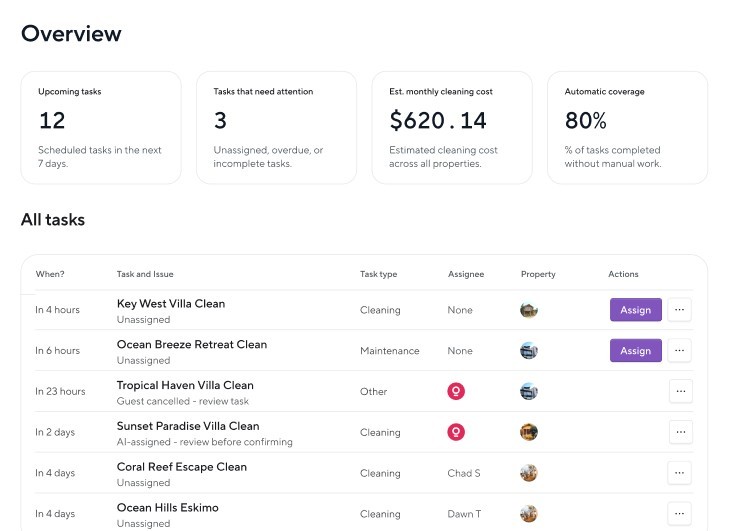
As you can see, every penny spent on keeping your rental property spotless and creating a welcoming environment for your guests directly reduces your taxable income. And if you choose Hospitable, you can set up task rules, and our system will automatically assign tasks to your cleaners whenever a reservation ends or a new guest arrives. With Hospitable Tasks, you can automate turnover cleanings and pay your cleaners and maintenance staff when their job’s done.
Travel expenses. Do you travel to inspect, maintain, or manage your short-term rental? If so, you can deduct travel-related expenses, such as actual vehicle expenses, airfare, lodging, and meals.
Platform and software fees. If you list your property on Airbnb, Vrbo, or other OTAs to reach potential guests, service fees and commissions that you pay to the platforms are tax-deductible. Running a successful short-term rental these days also means having the right tech tools that make hosting easier, such as property management software like Hospitable, accounting software like QuickBooks, smart locks and smart thermostat systems, etc. These tools keep your business running smoothly, and any money you spend on them is deductible.
Short-Term Rental Tax Benefits You Shouldn’t Miss
One of the overlooked tax benefits of short-term rentals is how they’re classified for tax purposes (it depends on the average length of guest stays and how involved you are in managing the property) and what that means for your income outside real estate.
Under the right conditions, STR income and losses are classified as non-passive. This means the losses generated by depreciation and cost segregation that exceed rental income can be used to offset W-2 wages, business income, or other ordinary income.
The short-term rental tax loophole offers unique benefits for property owners, so how do you qualify?
The average guest stay across all bookings at your STR property must be 7 days or fewer.
You must materially participate in running the property.
When you meet both requirements, the IRS classifies your rental income as non-passive, and you can deduct rental losses against W-2 income.
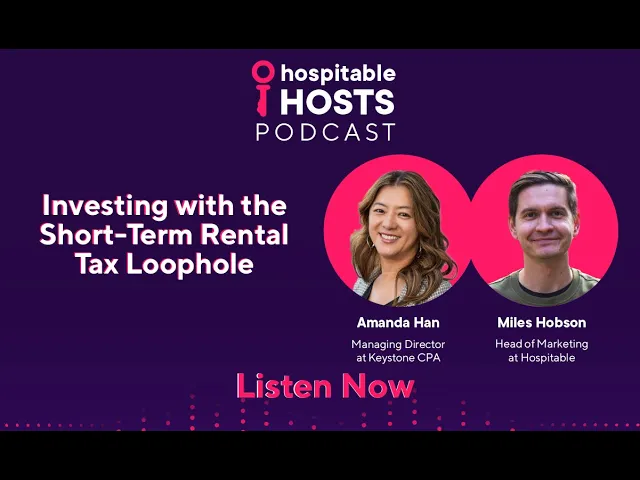
The IRS outlines several tests for material participation, and you only need to pass one to qualify. The most commonly used tests are:
You participated for more than 100 hours and more than anyone else involved in the activity did.
You participated in the activity for more than 500 hours during the year.
For most STR property owners, the 100-hour test is the easiest to meet. Activities that count toward material participation include communicating with guests, handling bookings, coordinating cleaners, inspecting the property, optimizing pricing, marketing, restocking supplies, and reviewing financials.
Remember that documentation is key. The IRS expects detailed time logs showing what you did and when. You can use apps or spreadsheets to prove your hours and involvement, and maintain consistent records throughout the year.
Final Thought
Taking advantage of available short-term rental tax deductions is a smart way to reduce your tax burden and increase profitability. If you meet the requirements, you can deduct several business-related expenses from the income of operating a short-term rental. However, all tax strategies require compliance with IRS rules and accurate documentation.
This article is for informational purposes only and does not constitute tax, legal, or financial advice. Tax laws change, and individual circumstances vary. Consult a qualified tax professional or CPA before making decisions based on the information presented here.



Table of contents
What Are Short-Term Rental Tax Deductions?
Key Short-Term Rental Tax Deductions You Can Claim
Short-Term Rental Tax Benefits You Shouldn’t Miss
Common questions
What are short-term rental tax deductions?
Short-term rental tax deductions are ordinary and necessary business expenses that property owners can subtract from taxable rental income to reduce the amount of tax they owe. Eligibility depends on how the property is used and whether the rental activity meets IRS requirements.
What expenses can short-term rental owners deduct?
Common deductible expenses can include mortgage interest, depreciation, property taxes, insurance premiums, utilities, repairs and maintenance, cleaning and turnover costs, travel related to managing the property, OTA service fees, and software or technology used to operate the rental. Improvements that add value to the property generally must be depreciated rather than deducted immediately.
What is the 14-day rule for short-term rentals?
To qualify for rental expense deductions, the property generally must be rented for more than 14 days per year, while personal use must not exceed 14 days or 10% of the total days it is rented, whichever threshold applies. If the property is rented for 14 days or fewer, the rental income is not reported, but rental expenses cannot be deducted.
What counts as material participation in a short-term rental?
Material participation means being actively involved in operating the rental. Common qualifying tests include participating for more than 100 hours and more than anyone else involved in the activity, or participating for more than 500 hours during the year. Activities can include guest communication, bookings, cleaner coordination, property inspections, pricing, marketing, restocking, and reviewing financials.
How do short-term rental tax deductions differ from long-term rentals?
Short-term rentals can qualify for tax treatment that is not typically available to traditional long-term rentals. If the average guest stay is 7 days or fewer and the owner materially participates, STR income and losses may be treated as non-passive, allowing qualifying rental losses to offset W-2 wages, business income, or other ordinary income.