Beginner's Guides
OTAs
Airbnb Rental Agreement: Pros and Cons
An Airbnb rental agreement is a legal contract between you and your guests, which sits outside of the Airbnb platform, giving you additional legal protection. But what should you put in the rental agreement? How do you send it to your guests?

You have the agreement drafted. It has been sitting in a folder for months because every time you think about adding it to your booking flow, you picture the same thing. A guest reads that they have to sign something, shrugs, and books the place down the road instead.
That fear is the main reason hosts never start. It is also, judging by our own data, unfounded.
We went through every US listing connected to Airbnb through Hospitable. The ones running agreements through our Rental Agreements flow, where the contract is generated for each booking and signed inside the guest portal, come out at higher occupancy than the ones with no agreement at all. Not lower. Higher.
The numbers are further down, along with what belongs in an agreement and how to get it in front of guests.
What to Put in Your Rental Agreement?
The information you put in your rental agreement is going to vary from host to host, but there are some basic points that you’ll more than likely want to cover:
Names: For any contract to be legally binding and effective, you must make sure that both parties’ full names engaging in the contract are present.
Location: Address must be included.
Booking details: The contract should outline the booking details: booking duration, dates, number of guests, check-in & check-out times, etc.
Fees: Outline the booking cost and any associated fees, e.g., cleaning and maintenance.
Parking: Add parking rules and instructions.
House rules: This is where you want to get specific about the conduct you expect from your guests during their stay, e.g., no parties, no pets, no loud noise after 10 pm, etc.
Host responsibilities: Outline the responsibilities and conduct you as a host will adhere to and uphold, e.g., what amenities you’ll provide, your commitment to responding to any problems, etc.
This list is by no means exhaustive, but it’s a good place to start when creating this important document. But to make your rental agreement legally binding, it’s essential to seek the advice of an attorney. Get your agreement checked off by an expert to ensure it stands up to scrutiny in your jurisdiction.
Airbnb Rental Agreement Template
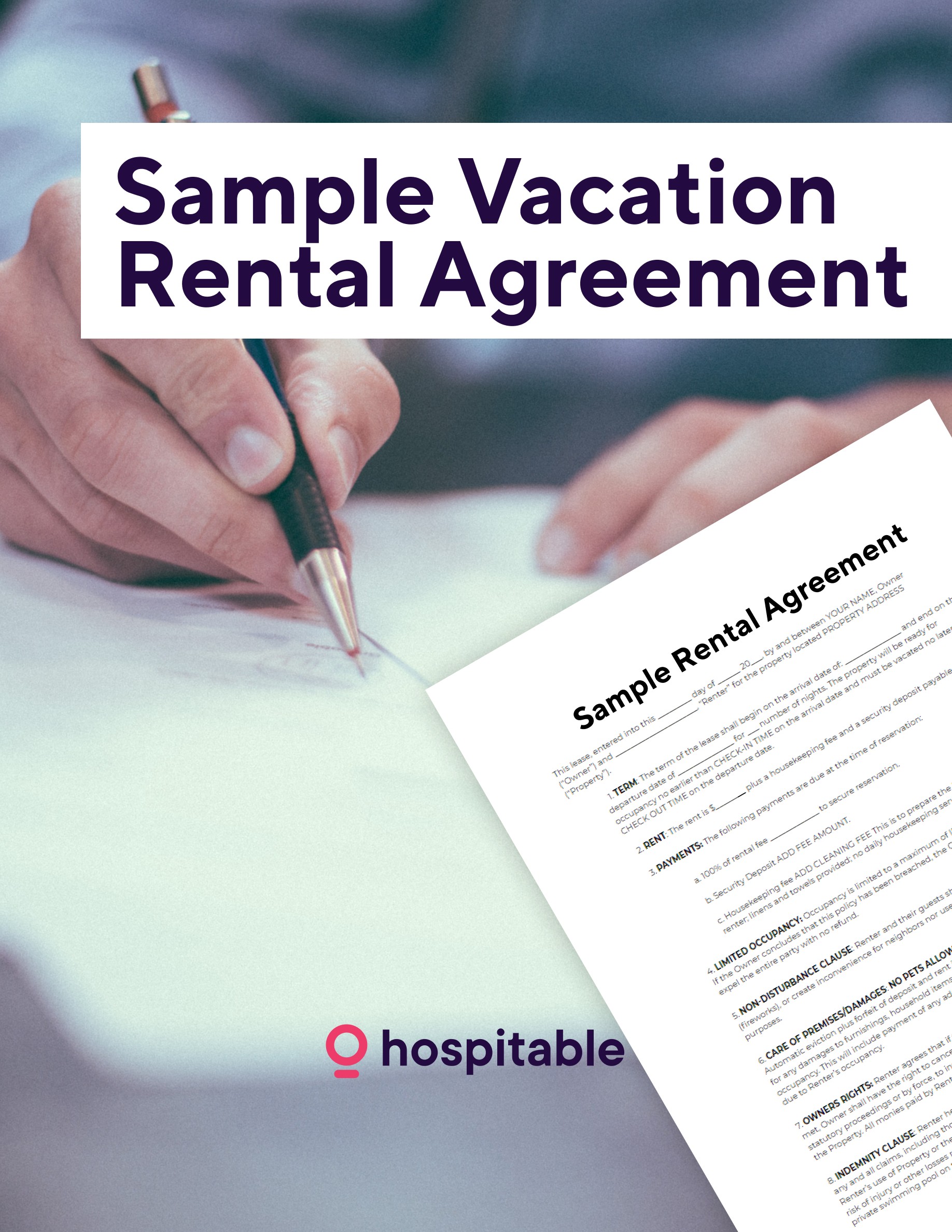
You can download our sample rental agreement for free. We cannot provide legal advice; please ensure that you adjust it to your specific jurisdiction and consult with a professional lawyer before using it.
How Many Hosts Actually Use Rental Agreements?
Across US listings connected to Airbnb through Hospitable, 4.4% have a rental agreement template switched on for Airbnb bookings.
So this is not standard practice. It is a minority habit, and the interesting part is which minority.
Property type | Share using a rental agreement |
Chalet | 10.4% |
Cabin | 8.2% |
House | 5.3% |
Cottage | 4.8% |
Townhouse | 3.3% |
Apartment | 3.0% |
Condominium | 3.0% |
Villa | 2.8% |
All property types | 4.4% |
US listings connected to Airbnb through Hospitable with an active Rental Agreement template, rolling 12 months.
The expensive-property theory does not survive this table. Villas carry the highest nightly rate of any major type at $567 and the lowest adoption at 2.8%. Cabins go for a little over half that and use agreements three times as often. Chalets top the list at 10.4%.
What cabins and chalets have in common is distance. Nobody is dropping by. If a booking turns into a party, the host hears about it afterward, from a neighbor or from the damage. Apartments and condominiums sit at the bottom on 3.0%, and those are the properties with a building manager, thin walls, and someone downstairs who will call.
The pattern is not price. It is how alone the property is.
How to Send a Rental Agreement to Your Guests
Airbnb stipulates that you must make your guests aware of your rental agreement BEFORE they make their booking. Failure to do this will render them null and void. This means that you’ll have to provide access to the rental agreement within your listing description.
Once you’ve covered that and your guests are aware of the agreement they are entering into, you’ll need to send this to them once they’ve booked. Airbnb requires you to include the full terms of your rental agreement in your message thread with the guest.
Then comes the hard part. Getting your guests to sign the contract and send it back to you! Once that’s done, the process is complete.
As you can see, although Airbnb allows you to ask your guests to sign a contract before staying at your rental, their website has no specific place to attach this document for guest review, let alone sign and return it.
However, using a property management system with the official Airbnb integration like Hospitable dramatically simplifies getting guests to sign a rental agreement. It can save you a lot of time with automation.
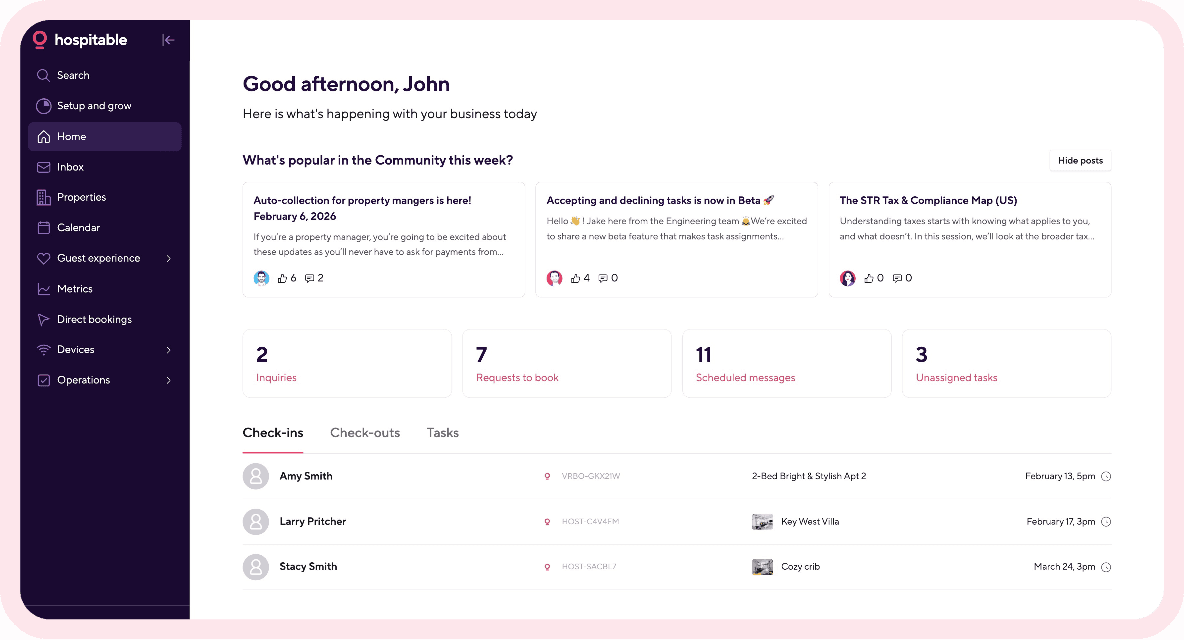
Hospitable has the Rental Agreements functionality, enabling hosts to create rental agreement templates and automatically send them to guests for signature. Moreover, this functionality also works for extra services like equipment rentals that you can offer your guests to enhance their stay and increase your Airbnb revenue.
With Hospitable, you can create a new rental agreement template or customize the existing one, including essential details to suit the needs of your vacation rental property. Then, our system will automatically generate a rental agreement for each new reservation, populating the template with guest and booking data.
Your guests will see their agreements in their guest portals as the registration task they must complete to finalize their booking. They can sign their contracts digitally, either by selecting a signature font or manually drawing a signature using their mouse, touchpad, or touchscreen.
If the guest does not sign the rental agreement, we’ll automatically send them a reminder two days after the booking. You’ll also be able to download all signed agreements in PDF format for your records.
Does Asking for a Signature Cost You Bookings?
The fear is that asking guests to sign something adds a step, and every extra step in a booking flow is somewhere to lose them. It is why most hosts never start.
So we looked at what happens to listings running that flow. For each of the four largest property types, we split US Airbnb listings into those running it and those running nothing, then compared occupancy across the last 12 months.
Property type | Occupancy, Hospitable agreement | Occupancy, no agreement | ADR, agreement | ADR, none |
House | 64.0% | 56.3% | $390 | $291 |
Apartment | 70.6% | 56.8% | $157 | $148 |
Condominium | 69.3% | 57.7% | $222 | $218 |
Cabin | 66.2% | 62.8% | $357 | $318 |
All four types | 65.8% | 57.2% | $271 | $254 |
US listings connected to Airbnb through Hospitable, four largest property types, rolling 12 months. The agreement group runs an active Rental Agreements template scoped to Airbnb. Occupancy is booked nights divided by bookable nights across each group. ADR is realized revenue per booked night.
Occupancy comes out higher in the agreement group in all four types. Apartments show the widest gap at close to 14 points, and they show it at almost the same nightly rate, so price is not doing the work there.
Two things this does not mean. It does not mean the agreement caused the occupancy. Hosts who set up rental agreements tend to be hosts who set up everything else too, and that habit is doing plenty of the lifting. The agreement group also skews toward larger portfolios, so a handful of well-run operations pull the average up.
What it does rule out is the collapse everyone worries about. Running agreements through Hospitable does not cost you bookings.
The Downsides of Airbnb Contracts
An Airbnb rental agreement can help you clearly outline your policies and guidelines on guest behavior as well as your responsibilities and ensure a smooth rental experience for you and your guests.
Yet, adding a rental agreement to your booking flow on Airbnb doesn’t come without its pitfalls and downsides, which are well worth considering before you choose to proceed further.
Airbnb doesn’t have your back
This rental contract is between you and your guests and has nothing to do with the Airbnb company whatsoever. Airbnb clearly states they can’t help enforce special policies in your contract.
Therefore, you won’t be getting any help from them as an intermediary in the case of any disputes. Instead, any disputes must go through the regular legal process, often involving lawyers and courts, which can get expensive.
Workload
If you’re a busy host (which I hope you are), then building a new contract for every new booking can be a bit of a headache if you do everything manually.
On top of that, you’ll have to chase guests for signed contracts along the way. But it’s no problem if you opt for Hospitable, which lets you automatically template agreements and send them to your guests for signature.
Hospitable will also help you save time by automating 90% of daily hosting tasks and putting your Airbnb business on autopilot.
Put off your guests
Nobody likes being told what to do, right? And guests are not obliged to sign anything.
So make sure your rental agreement doesn’t read like a textbook of rule after rule of what your guests can’t do because then you’ll lose bookings to your competitors.
Airbnb Rental Agreement: What Are the Benefits?
Ok, so we’ve looked at the downsides of Airbnb contracts; now, what about the benefits?
Long-term tenants
Did you know that after a certain period, your guest rights change from short-stay tenant to long-term tenant, with all the rights that come with it?
Well, it’s true. Depending on your jurisdiction, this switch can happen in as little as 30 days!
That’s where an Airbnb long-term rental agreement can come in handy. Otherwise, you could find yourself with tenants in your property that you can’t get rid of. Learn more about Airbnb squatters in our dedicated article.
Peace of mind
That’s right; you get to sleep at night knowing you’re protected from any foul play from guests when renting your home to strangers. The rental agreement also sets guidelines for guest behavior, leading to fewer misunderstandings and reducing the risk of disputes.
Damage control
When damages happen, which doesn’t mean that they inevitably will, you’ll have legal recourse to recoup the costs of these damages.
Sure, you get covered (to an extent) by the Host Damage Protection as a part of Airbnb’s AirCover for Hosts, but having your rental agreement in place is far more solid and robust.
Tenant screening
A rental agreement will likely act as a screening process, helping you avoid troublesome guests before they even book. If potential guests are not going to obey your rules about noise or plan to invite extra guests, they’re unlikely to sign the contract.

What About Other Platforms?
Like Airbnb, it’s possible to add additional rental agreements on Vrbo. In fact, with Vrbo, they even let you upload the rental agreement to their system, which is pretty neat.
All the same rules and recommendations apply, so what works for your Airbnb rental contract will work for Vrbo, as well. You might just need to adjust a few bits here or there to make it fit for each platform.
Remember that Hospitable’s Rental Agreement functionality is available for all our users and works on different booking channels, including Airbnb, Vrbo, Booking.com, Agoda, and your direct booking website.
Conclusion
Adding an Airbnb lease agreement to your booking flow adds a step. Make that step small enough, and the hosts running it are not losing bookings over it.
And it’s also worth remembering that the rental agreement is between you and your guest. NOT with Airbnb as an intermediary. Any problems/claims must be reconciled between the two of you amicably or in a courtroom.
But as with many things in life, the threat of legal action alone is often enough of a deterrent to make people compliant, which is what you really want, right?
A well-defined Airbnb rental agreement can help ensure that you and your guests are on the same page, preventing miscommunication and conflicts and protecting both parties.
Providing a formal agreement also creates a sense of professionalism and helps build trust.
So, should you add a short-term rental agreement to your Airbnb? The hosts who already did it, through a flow their guests finish in under a minute, are running at 65.8% occupancy against 57.2% for everyone else. Whatever is holding you back, it should not be the fear of an empty calendar.


Table of contents
Common questions
Do you need a rental agreement for Airbnb?
Airbnb does not require every host to use a separate rental agreement, but hosts can require one as part of the booking process. A rental agreement can clarify house rules, guest responsibilities, fees, booking terms, and host obligations, which helps reduce misunderstandings and gives hosts additional protection if disputes or property damage occur.
What should an Airbnb rental agreement include?
An Airbnb rental agreement should include the full names of both parties, the property address, booking dates, number of guests, check-in and checkout times, rental costs and fees, parking instructions, house rules, and the host’s responsibilities. The exact terms should reflect the property and local laws, and the agreement should be reviewed by a qualified attorney to make sure it is enforceable in the relevant jurisdiction.
Can a rental agreement reduce Airbnb bookings?
A rental agreement does not necessarily reduce bookings if the signing process is simple. Among US Airbnb listings connected through Hospitable, the four largest property types using Hospitable Rental Agreements averaged 65.8% occupancy, compared with 57.2% for listings without an agreement. This does not prove that rental agreements increase occupancy, but it does show that using one through a streamlined booking flow is not associated with the booking drop hosts often fear.
How can you automate Airbnb rental agreements?
Hospitable lets hosts create a reusable rental agreement template and automatically generates a contract for each new reservation using the relevant guest and booking data. Guests receive the agreement in their Guest Portal, sign it digitally, and automatically receive a reminder if they have not signed within two days. Signed agreements can also be downloaded as PDFs for record-keeping.
Can you use the same rental agreement across Airbnb, Vrbo, and Booking.com?
Yes, the same core rental agreement can be used across multiple booking channels, although some terms may need to be adjusted for each platform. Hospitable’s Rental Agreements feature works with Airbnb, Vrbo, Booking.com, Agoda, and direct booking websites, allowing hosts to manage agreements across channels from one system.