Property Management
Vacation Rental Trust Accounting in Australia
Property management trust accounting software can help Australian STR property managers automate reconciliation and financial reporting. Find out what to look for.

When you manage properties for other people, the money that guests pay for staying in a vacation rental doesn’t belong to you—it belongs to the property owner. Until you’ve taken your property management fee and disbursed the rest according to the terms of your vacation rental property management agreement, you’re holding funds in trust on the owner’s behalf.
You’re responsible for tracking owner money accurately and paying it out correctly. This is where trust accounting comes in. This financial framework separates client money from operating money to prevent commingling, tracks every dollar to its rightful owner, and creates a clear audit trail.
In this blog, we’ll discuss what trust accounting means for short-term rental property managers, why it matters, and how it works in practice. We’ll also cover legal requirements for trust accounting in Australia and how property management trust accounting software can streamline compliance and make it manageable at scale.
What Is Vacation Rental Trust Accounting?
Trust accounting is the financial practice of holding and managing money on behalf of someone else. In vacation rentals, this means keeping owner and guest funds in accounts separate from the property manager’s own operating cash, tracked at the owner or property level and reconciled regularly.
In practice, vacation rental trust accounting requires creating dedicated bank accounts, careful tracking of every transaction, and clear reporting that shows property owners exactly what happened with their funds. This ensures that rental income, security deposits, advance payments for future stays, and other owner funds are protected and properly accounted for.
Trust accounting isn’t just best practice that protects your property management business from cash flow surprises and owner disputes. For many property managers, it’s a legal requirement. Failure to comply creates extensive problems—it can result in fines, license revocation, or legal action.
Trust accounting creates the financial foundation for growing a sustainable STR property management business. You’ll be able to scale faster if you automate your routine property management tasks using a robust property management system like Hospitable. Our STR super app allows you to run your business on autopilot and focus on strategic growth.
Trust Accounting in Australia
Trust accounting requirements in Australia vary by state and territory. However, short-term rental managers in Australia may be required to comply, depending on their state or territory and how they operate, with these fundamental trust accounting rules:
Segregation of funds—keep trust money separate from operating money and never mix it. Some property managers maintain one pooled trust account for all owners, with sub-ledger tracking for each, while others use separate accounts where required, depending on the legislation.
Accurate record keeping—maintain detailed, up-to-date records of all financial transactions (what it was for, which property and owner it relates to, and when it occurred) and, in some states and territories, issue receipts for all guest money received.
Regular reconciliation—conduct regular three-way reconciliation (monthly in most states and territories) between the trust account bank statement balance, the trust cash book balance, and the total of individual client ledgers to verify that these numbers match exactly. Any discrepancy, no matter how small, should be investigated and resolved as soon as possible.
Timely fund disbursements—ensure timely payments to property owners (along with owner statements) according to the schedules specified in your management agreements.
Be audit-ready—organize and maintain all financial records and documentation systematically to facilitate efficient audits by regulatory authorities when required.
Legislation requires property management companies to explain and provide evidence of what happened to trust money at any time. In other words, the focus is on safeguards and accountability.
While the principles are consistent, each Australian state and territory administers trust accounting through its own legislation (Property and Stock Agents Act 2002 (NSW), Estate Agents Act 1980 (VIC), Property Occupations Act 2014 and Agents Financial Administration Act 2014 (QLD), Real Estate and Business Agents Act 1978 (WA), Land Agents Act 1994 (SA), Property Agents and Land Transactions Act 2016 (Tasmania), Agents Act 2003 (ACT), Agents Licensing Act 1979 (NT).
It’s important to remember that the exact account types, reconciliation frequency, reporting obligations, audit requirements, and who can perform audits depend on the relevant state/territory legislation. So, check your state/territory government website for guidance. This article is for general information only and isn’t legal or financial advice. Requirements differ between states and territories and change over time, so always check the current legislation and your regulator’s guidance, and consult a qualified lawyer or accountant about your specific situation.
For example, the NSW Government explains requirements for holding clients’ money in a trust account, managing trust accounts, and meeting audit obligations. Queensland outlines trust account requirements and audit expectations for handling trust money in the property industry as well. Western Australia Consumer Protection published The Real Estate and Business Agents' Trust Account Handbook, which explains the trust account requirements agents handling client funds must meet under the Act and Regulations.
Short-Term Rental Trust Accounting: What Makes It Harder
Most trust accounting guidance was written for long-term rentals, where the underlying transactions are simpler since a tenant pays rent once a month on a predictable schedule. Short-term rental trust accounting uses the same core rules but layers complexity on top:
A single owner’s revenue for a month might come from multiple different reservations, booked through different channels.
OTAs batch payouts, net their own fees, and settle on their own schedule.
Canceled bookings, partial refunds, and chargebacks complicate balances.
Beyond the owner, you may be tracking vendor payments for cleaning or maintenance.
For example, one Airbnb payout might represent 6 different reservations across 4 different properties with 4 different owners. That means short-term rental trust accounting has to solve a problem long-term rental trust accounting doesn’t. It must match a single, blended payout back to the individual bookings, properties, and owners it belongs to before any funds can be correctly segregated.
Property Management Trust Accounting Software: What to Look For
Accurate trust accounting protects your clients and your STR property management business. However, handling trust accounting manually across many properties and multiple channels (e.g., Airbnb, Vrbo, direct bookings) in spreadsheets is unsustainable. As your portfolio grows, manual data entry leads to human error and increases the risk of duplicate entries, missed expenses, and reporting inconsistencies.
Trust accounting for short-term rentals is complicated, but the right property management software makes it a workflow, not a burden. For example, Hospitable is all-in-one short-term rental property management software that not only runs the operational side of the business but also includes features that support trust accounting workflows to keep the money side in order.
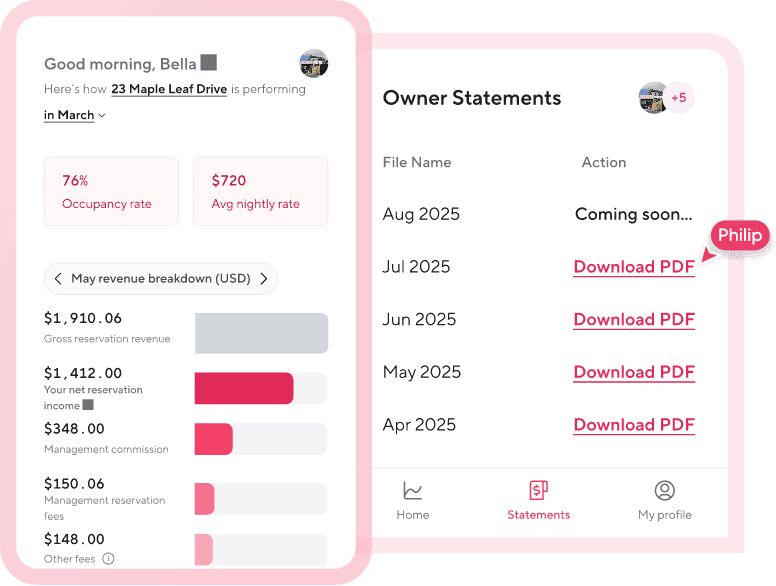
Hospitable helps property managers efficiently track income and expenses, maintain compliance, and provide transparent financial reporting to property owners through monthly owner statements. They are generated automatically every month for each property that has an owner and a management agreement, and owners can review published statements in their Owner Portal.
Owner statements also absorb the complications that make short-term rental trust accounting harder. Each management agreement sets how revenue is recognized, at check-in, at checkout, or prorated across the nights of the stay, so a reservation that spans two months lands in the right statement period. And if a reservation is altered, canceled, or refunded after a statement has been marked as paid, Hospitable doesn’t reopen the locked statement. It automatically adds an adjustment to the next month’s statement instead, so every change leaves a visible trail rather than quietly rewriting records.
Property managers in Australia who operate a trust account, keeping owner funds separate from their business operating account, can also take advantage of Hospitable’s Trust Accounting feature. It makes it easy to sync your trust account bank feed every day, reconcile your bank transactions, manage your ledgers, and generate the reports your auditor needs.
Hospitable Trust Accounting connects directly to your bank, reads your Hospitable owner statements, and suggests a match from them for every transaction in your trust account bank feed. Each bank transaction appears next to its suggested match from your owner statement. You can review the match and then record it. Your reports update as you reconcile, and you can print them, save them, or export them to Excel.
Each of the trust accounting rules covered above maps to a step in the workflow. Platform payouts are recorded as numbered receipts on the right owner’s ledger; every owner and property gets its own ledger that can’t be overdrawn, and the trust account reconciliation report confirms that your bank balance, cash book, and ledger totals agree. When you close the month, a permanent record of the cash book, ledger balances, and reconciliation stays on file for your auditor.
When you set up Hospitable Trust Accounting, rules such as how long you keep records, deposit deadlines, and report formats are set for your state or territory.
With Hospitable, trust accounting sits in the same platform as your reservations and owner statements, so there’s no exporting data into a separate tool. Hospitable brings together data from all your channels and turns reconciliation into reviewing suggested matches, helping property managers cut manual work and keep clear, audit-ready records at scale.


Table of contents
Common questions
Is trust accounting mandatory for vacation rental property managers in Australia?
Trust accounting may be mandatory for vacation rental property managers in Australia, depending on the state or territory and how the business handles client funds. Managers who hold rental income, security deposits, or other money on behalf of property owners may need to maintain a designated trust account and comply with specific recordkeeping, reconciliation, and audit requirements. The exact obligations vary by jurisdiction.
What are the main trust accounting requirements in Australia?
The main requirements typically include keeping client funds separate from business operating money, maintaining accurate transaction records and owner ledgers, performing regular three-way reconciliations, disbursing funds according to management agreements, and maintaining audit-ready documentation. Three-way reconciliation compares the trust bank balance, cash book balance, and combined client ledger balances. Monthly reconciliation is required in most states and territories, but exact rules vary by jurisdiction.
Why is trust accounting more complicated for short-term rentals?
Short-term rentals generate frequent transactions across multiple booking channels, with different payout schedules, platform fees, cancellations, refunds, and chargebacks. A single OTA payout may combine several reservations across different properties and owners, making it necessary to allocate each amount accurately before recording or distributing funds. This creates more reconciliation work than traditional long-term rentals, where payments are generally more predictable.
What should Australian property managers look for in trust accounting software?
Australian property managers should look for software that supports dedicated owner and property ledgers, bank feed integration, transaction matching, three-way reconciliation, owner statements, audit-ready reports, and state-specific compliance settings. Hospitable Trust Accounting connects bank transactions with owner statements, suggests matches for review, maintains reconciliation records, and supports reporting and Excel exports. It also keeps trust accounting connected to reservations and financial data across booking channels, reducing manual reconciliation work.